

What Makes A Good Minister of Jesus Christ? A New Testament Portrait of Faithful Ministry

Updated: Jul 26
Rethinking Ministry Success in Light of Scripture
“If thou put the brethren in remembrance of these things, thou shalt be a good minister of Jesus Christ…” (1 Timothy 4:6)
What makes a good minister of Jesus Christ?
It is one of the most important questions a pastor can ask.
In every generation, Christians have attempted to define faithful ministry. Conferences, books, seminaries, leadership podcasts, and research studies all seek to identify the characteristics of effective pastors.
Yet before listening to contemporary voices, we should first ask a more fundamental question:
How does God define a good minister?
When the Apostle Paul instructed Timothy regarding pastoral ministry, he did not point him to a competency model. He did not provide a list of seventy-six core competencies or one hundred twenty-nine leadership traits. Instead, he offered a remarkably simple statement:
“If thou put the brethren in remembrance of these things, thou shalt be a good minister of Jesus Christ.”
The simplicity of that statement is striking.
Paul does not mention attendance figures.
He does not mention budgets.
He does not mention conference invitations.
He does not mention influence, branding, networking, or public recognition.
Instead, he describes a faithful shepherd who continually nourishes himself in sound doctrine and faithfully reminds God’s people of biblical truth. This does not mean that leadership skills are unimportant. A pastor who learns to communicate clearly, organize effectively, and lead wisely will often be more effective in ministry. The issue is not whether competencies have value.
The issue is whether competencies have become substitutes for biblical qualifications.
If you will meditate on that statement for a moment you will realize that distinction is crucial.
Research Analysis Series
Volume 1 | Article 3
Biblical Leadership Studies
What Makes a Good Minister of Jesus Christ?
A New Testament Priority Model Compared with Modern Leadership Competency Frameworks
The New Testament qualifications for church leaders are overwhelmingly character-based. God is concerned with faithfulness, godliness, doctrine, integrity, humility, self-control, and spiritual maturity. The emphasis is not primarily on what a man can do, but on what a man is.
Let us consider the portrait that emerges from the New Testament. We will consider from two angles/parts.
Part One: The Biblical Portrait of a Good Minister
The New Testament provides a remarkably consistent portrait of faithful ministry. While the passages are scattered throughout the Pastoral Epistles and other ministry texts, they combine to form a comprehensive picture of what God values in His servants. THE FIRST TEN WILL BE HIGHLIGHTED AND THEN A TABLE WILL BE OFFERED WITH A MORE THROUGH AND COMPLETE LISTING.
1. A Good Minister Reminds God’s People of Truth
“If thou put the brethren in remembrance of these things…” (1 Timothy 4:6)
The first characteristic Paul mentions is remarkably simple. A good minister continually reminds believers of biblical truth. Much pastoral ministry is not discovering something new. It is faithfully repeating what God has already said.
Believers need reminders. Churches need reminders. Pastors must continually bring God’s people back to sound doctrine, biblical priorities, and gospel truth.
The faithful pastor understands that repetition is not failure. It is shepherding.
2. A Good Minister Is Nourished by Sound Doctrine
“Nourished up in the words of faith and of good doctrine…” (1 Timothy 4:6)
A pastor cannot consistently feed others if he is not feeding himself.
Before a minister stands before a congregation, he must sit before the Scriptures. Before he teaches truth, he must be nourished by truth. The ministry is not sustained by charisma, personality, or natural ability. It is sustained by God’s Word.
3. A Good Minister Pursues Godliness
“Exercise thyself rather unto godliness.” (1 Timothy 4:7)
The New Testament places greater emphasis on character than on giftedness.
A gifted man may attract a crowd.
A godly man pleases God.
The Lord is more concerned with what a minister is becoming than with what he is building.
4. A Good Minister Is an Example
“Be thou an example of the believers…” (1 Timothy 4:12)
Paul specifically mentions speech, conduct, love, spirit, faith, and purity.
Pastors teach with sermons, but they also teach with their lives.
The congregation should be able to observe in their pastor a living example of Christian maturity.
5. A Good Minister Gives Himself to Scripture
“Give attendance to reading, to exhortation, to doctrine.” (1 Timothy 4:13)
The ministry of the Word remains central to pastoral ministry.
Programs have their place. Administration has its place. Organization has its place.
But a pastor’s primary calling is to know, teach, and apply the Scriptures.
The pulpit is not sustained by creativity. It is sustained by truth.
6. A Good Minister Watches His Life and Doctrine
“Take heed unto thyself, and unto the doctrine.” (1 Timothy 4:16)
A pastor must guard both his character and his convictions.
Orthodoxy without holiness is dangerous.
Holiness without sound doctrine is unstable.
A faithful minister pursues both.
7. A Good Minister Endures Hardness
“Thou therefore endure hardness, as a good soldier of Jesus Christ.” (2 Timothy 2:3)
The New Testament never portrays ministry as easy. There are disappointments, criticisms, betrayals, setbacks, discouragements, and seasons of weariness.
A good minister is not one who avoids hardship.
He is one who remains faithful through hardship.
8. A Good Minister Preaches the Word
“Preach the word.” (2 Timothy 4:2)
As Paul approached the end of his life, his instructions became remarkably focused.
Not...
entertain the people.
build a platform.
cultivate a brand.
Preach the Word.
The minister’s reward does not come from his personality. It comes from faithfully feeding the flock with the message God has entrusted to him.
9. A Good Minister Equips Others
“For the perfecting of the saints, for the work of the ministry…” (Ephesians 4:12)
Pastors are not called to do all the ministry.
They are called to prepare God’s people for ministry.
Healthy churches are built when believers are equipped, encouraged, and mobilized to serve Christ.
10. A Good Minister Is Faithful
“It is required in stewards, that a man be found faithful.” (1 Corinthians 4:2)
This may summarize every other characteristic.
God has not called every pastor to the same assignment.
Some shepherd large congregations.
Some labor in rural communities.
Some serve in church plants.
Some invest decades in church revitalization.
Some minister in places where few people notice their labor except God.
The issue is not prominence.
The issue is faithfulness.
One pastor may influence thousands. Another may influence dozens. If both faithfully discharge their stewardship before God, both are good ministers of Jesus Christ.
30-TRAIT SCRIPTURAL SUMMARY REFERENCE
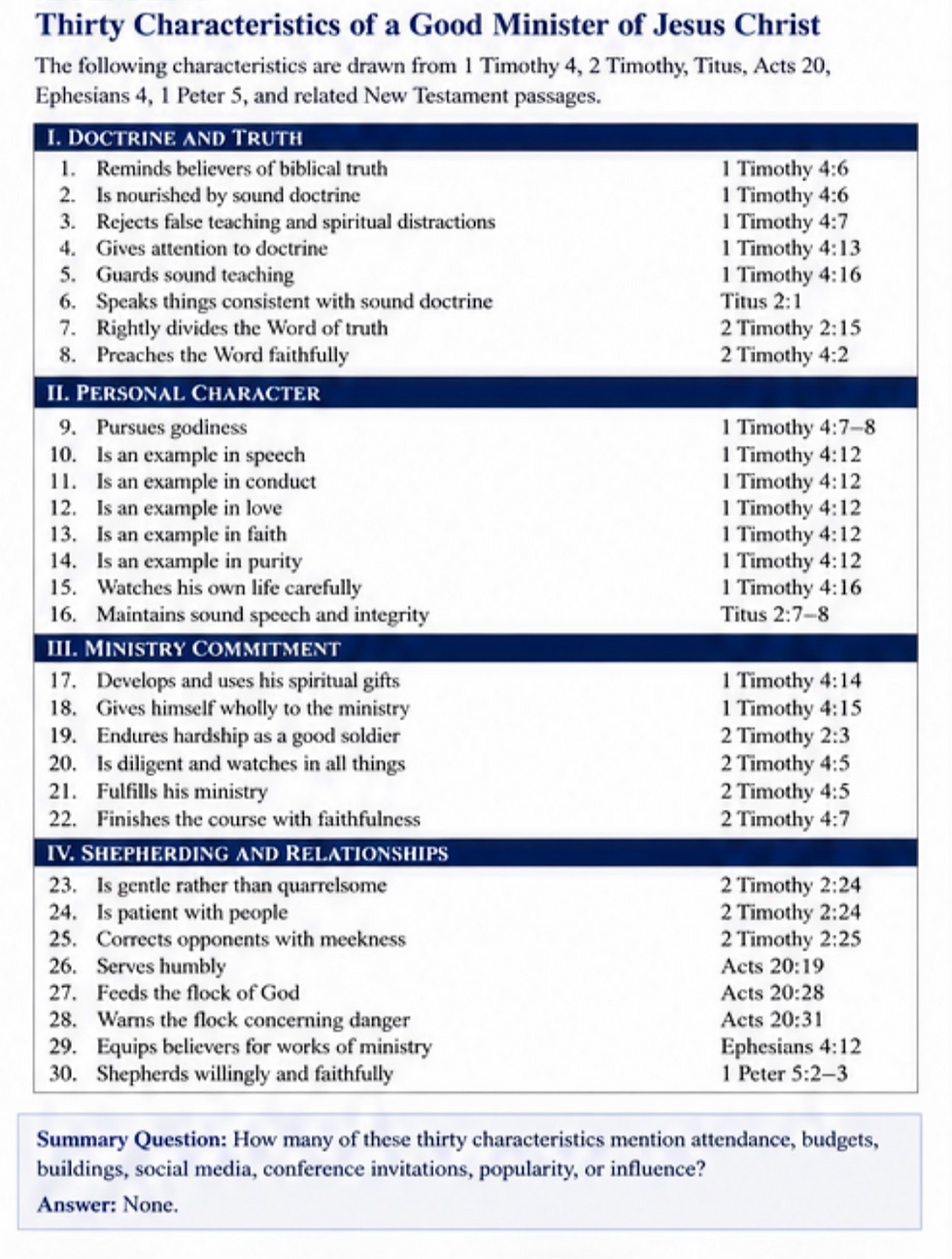
Having surveyed the principal New Testament passages on pastoral ministry, a clear pattern begins to emerge. Although these texts address different ministry settings and circumstances, they consistently emphasize certain pastoral priorities with remarkable unity. Character, doctrinal fidelity, faithfulness, shepherding, and the ministry of the Word repeatedly occupy the center of the apostolic instruction.
To help visualize this pattern, Figure 1 presents a Relative Emphasis Index (REI) developed from a qualitative analysis of the New Testament’s pastoral texts. The figure is not intended as a statistical measurement, but as a visual model that illustrates the relative emphasis Scripture places upon the defining priorities of faithful ministry. By organizing these recurring themes into a comparative framework, the figure provides a concise summary of the New Testament’s portrait of a good minister of Jesus Christ.
Interpretation of Figure 1
The significance of Figure 1 is not that lower-ranked categories are unimportant, but that the New Testament consistently establishes an intentional order of emphasis. Character, doctrine, and faithfulness define the minister. Shepherding, preaching, personal example, equipping, and endurance describe how that character is expressed in faithful pastoral ministry.
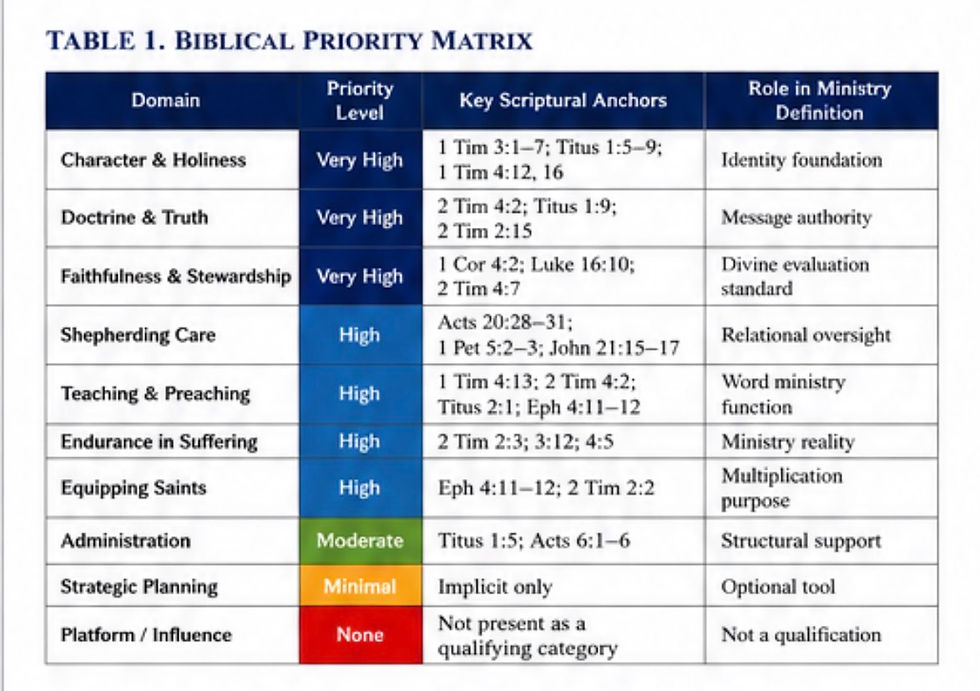
While Figure 1 provides a visual summary of the New Testament’s relative emphasis on pastoral priorities, Table 1 presents the analytical framework underlying that model. Each category has been evaluated according to its frequency across the principal pastoral texts, its placement within explicit qualifications and ministerial commands, and its theological centrality to the biblical portrait of a faithful minister. Together, the figure and the table demonstrate that the New Testament consistently prioritizes character, doctrine, and faithfulness as the defining qualities of pastoral leadership, while viewing other aspects of ministry as important expressions flowing from these foundational realities.
NEW TESTAMENT PRIORITY MATRIX: Analytical Framework for Evaluating Ministerial Priorities
Meditation Thought
Our generation often measures ministers by visibility.
The New Testament measures ministers by faithfulness.
A good minister is not necessarily the most gifted preacher, the most recognized leader, the most followed voice, or the most influential personality. A good minister is one who faithfully teaches the Word of God, pursues godliness, loves God’s people, endures hardship, guards sound doctrine, and fulfills the ministry entrusted to him by Christ.
Many pastors labor in obscurity.
They preach week after week to small congregations.
They visit the sick.
They pray with struggling families.
They counsel hurting people.
They teach the Scriptures.
They remain at their post year after year.
The world may never know their names.
But heaven does.
And according to the Word of God, such men may truly be good ministers of Jesus Christ.
Part Two: Comparing Modern Leadership Models with Biblical Qualifications
Modern ministry literature frequently examines pastoral leadership through analytical frameworks that differ from the qualification passages of the New Testament. Rather than asking who a minister must be, these studies often explore the knowledge, skills, behaviors, and competencies that contribute to effective ministry within a particular context.
One notable example is Joseph Hudson’s 2017 doctoral dissertation, A Competency Model for Church Revitalization in Southern Baptist Convention Churches: A Mixed Methods Study. Hudson sought to identify the competencies associated with effective church revitalization. Using an exploratory sequential mixed-methods design that combined qualitative interviews with a Delphi panel of experienced pastors, he developed a competency model consisting of expert, core, and supplemental competencies.
Hudson’s research makes a valuable contribution to the study of church revitalization by identifying qualities that practitioners believe contribute to effective ministry. Importantly, however, his study was not designed to redefine the biblical qualifications for pastoral office. Rather, it sought to identify competencies that may strengthen the effectiveness of ministers already serving in that role.
That distinction is essential. Competencies may contribute to ministry effectiveness, but they should not be confused with the qualifications by which Scripture defines a faithful minister. The New Testament first establishes who a minister must be before describing what he must do or identifying the abilities that may enhance his service.
Model One: Competency-Based Leadership
Competency models seek to identify the skills, behaviors, and abilities associated with successful leadership performance.
Research studies frequently identify dozens of competencies that distinguish highly effective leaders from average leaders. Such competencies often include strategic planning, organizational development, communication skills, team building, vision casting, conflict management, adaptability, innovation, and change leadership.
These competencies may improve effectiveness. However, Scripture rarely presents them as qualifications for pastoral office. The primary question of competency-based leadership is:
“Can this person perform effectively?”
Model Two: Giftedness-Based Leadership
A second approach emphasizes strengths, talents, spiritual gifts, and natural abilities.
This model recognizes that God gifts believers differently and that ministry effectiveness often increases when leaders operate within their areas of strength.
This perspective offers valuable balance because Scripture clearly teaches spiritual gifts. The primary question of giftedness-based leadership is:
“What is this person gifted to do?”
Model Three: Qualification-Based Leadership
The New Testament focuses primarily upon qualifications rather than competencies.
Paul’s lists in 1 Timothy 3 and Titus 1 emphasize character, doctrine, self-control, integrity, family leadership, and spiritual maturity.
The primary question of qualification-based leadership is:
“What kind of person is this man?”
Before God examines a leader’s methods, He examines his character.
Before God evaluates performance, He evaluates faithfulness.
SUMMARY:
COMPARING THREE MODELS OF LEADERSHIP
Model A Competency-Based | Model B Giftedness-Based | Model C Qualification-Based |
Focuses on skills | Focuses on strengths | Focuses on character |
Measures performance | Measures ability | Measures faithfulness |
Asks what a leader can do | Asks what a leader does well | Asks what kind of person he is |
Values effectiveness | Values giftedness | Values godliness |
Helpful for development | Helpful for placement | Essential for leadership |
Useful | Valuable | Required |
The Danger of Substitution
Problems arise when competencies replace qualifications. A church may become impressed with a leader’s abilities while overlooking deficiencies in character.
A pastor may feel discouraged because he lacks certain leadership skills while overlooking the biblical qualities he faithfully demonstrates.
Scripture never teaches that strategic brilliance compensates for spiritual immaturity. Nor does Scripture teach that charisma can substitute for character.
God’s qualifications remain unchanged.
Encouragement for Faithful Pastors
This truth should encourage pastors everywhere.
Not every pastor will shepherd a large congregation.
Not every pastor will become widely known.
Not every pastor will write books, speak at conferences, or influence thousands of people.
Many faithful pastors labor in places that will never attract national attention. Week after week they preach the Word to small congregations. They visit hospitals, counsel struggling families, disciple believers, pray for their people, and quietly endure seasons of discouragement and hardship. Their names may never become widely recognized, yet their labor is precious in the sight of God.
Because modern ministry culture often celebrates visibility, influence, and measurable success, many of these pastors quietly wonder whether they are failing.
The New Testament offers a wonderfully liberating answer.
Faithfulness—not fame—is God’s standard.
Every pastor can pursue the qualities God requires.
Every pastor can be faithful.
Every pastor can cultivate godliness.
Every pastor can teach sound doctrine.
Every pastor can love God’s people.
Every pastor can faithfully fulfill the stewardship Christ has entrusted to him.
The New Testament’s definition of a good minister is both more demanding and more attainable than many modern definitions. It is more demanding because it reaches beyond methods and abilities into the realm of character. Yet it is also more attainable because it is not dependent upon personality, giftedness, opportunity, platform, or public recognition.
A pastor serving twenty people in a rural congregation may be every bit as faithful in the eyes of God as a pastor serving thousands. Likewise, a pastor serving thousands may be every bit as faithful as a pastor serving twenty.
God has never measured faithfulness in square footage, attendance, or influence. He measures ministers by their stewardship of the life, doctrine, and flock He has entrusted to their care.
A pastor may possess dozens of leadership competencies and still fail spiritually.
Another pastor may never appear on a conference platform, yet faithfully fulfill every biblical qualification God requires. The Lord does not evaluate His servants primarily by influence, popularity, attendance, recognition, or organizational success.
He evaluates them by faithfulness.
Competencies may enhance ministry. Giftedness may expand ministry opportunities. But character, doctrine, godliness, and faithfulness remain the defining marks of a good minister of Jesus Christ.
Therefore, before we ask whether a pastor possesses the competencies associated with successful leadership, we should first ask whether he possesses the qualities Scripture associates with a good minister of Jesus Christ.
Toward A Biblical Taxonomy of Pastoral Leadership
From Qualifications to Competencies: Clarifying the Categories
Before comparing the New Testament with contemporary leadership models, an important distinction must be made. Modern competency research is often misunderstood because it attempts to answer a different question than Scripture’s pastoral qualification passages.
The qualifications of an elder in 1 Timothy 3 and Titus 1 answer the question:
Who must a minister be?
Competency models attempt to answer another question: What knowledge, skills, and abilities help a minister perform effectively?
These are not identical questions. In fact, they belong to different categories.
Failure to distinguish these categories often creates unnecessary tension between biblical qualifications and leadership development.
A Biblical Taxonomy of Pastoral Leadership
Evaluating Hudson’s Competency Model
Joseph Hudson’s 2017 mixed-methods study represents one of the most comprehensive attempts to identify competencies associated with successful church revitalization. His Delphi panel identified 36 expert competencies, 71 core competencies, and 22 supplemental competencies.
Interestingly, Hudson’s highest-rated competencies are overwhelmingly biblical in character.
Among his expert competencies are:
Love for God
Love for the Bible
Humility
Godliness
Prayerfulness
Holiness
Commitment to Bible centrality
Commitment to preaching
Undershepherd mentality
These are not merely leadership skills; they are qualities deeply rooted in the New Testament’s own portrait of pastoral ministry.
However, Hudson’s model also includes organizational competencies, interpersonal skills, strategic planning, technological ability, contextual awareness, and other leadership capacities that serve a different purpose. These competencies may contribute to ministry effectiveness without functioning as biblical qualifications for pastoral office.
The distinction is important. Scripture defines who may serve as an overseer. Competency models explore how an already qualified minister may serve more effectively within a particular ministry context.
Based on what has been presented in this article, a Biblical Taxonomy of Pastoral leadership naturally presents itself.
Final Synthesis
The New Testament presents a remarkably consistent portrait of a faithful minister. Rather than beginning with ministry techniques or measurable outcomes, the apostolic writings begin with the man himself. Before describing what a minister must do, Scripture first establishes who a minister must be.
This study has proposed a biblical taxonomy of pastoral leadership that distinguishes four related, yet distinct, categories:
Qualifications — Who must the minister be?
Functions — What must the minister do?
Competencies — What knowledge, skills, and abilities may enhance his effectiveness?
Outcomes — What results may God, in His sovereignty, choose to produce through a faithful ministry?
Recognizing these distinctions helps reconcile the relationship between biblical qualifications and modern leadership research. Competency studies, such as Joseph Hudson’s work on church revitalization, offer valuable insights into the abilities that may strengthen pastoral effectiveness. Many of Hudson’s highest-rated competencies—including love for God, humility, prayerfulness, commitment to Scripture, holiness, and Bible-centered preaching—beautifully reflect the priorities of the New Testament.
At the same time, competency models frequently include organizational, strategic, interpersonal, and contextual skills that serve a different purpose than the qualifications set forth in Scripture. These competencies may contribute to effective ministry, but they do not define ministerial identity.
The New Testament consistently defines a good minister through qualities such as character, doctrinal fidelity, faithfulness, shepherding care, endurance, and a steadfast commitment to the ministry of the Word. These are not merely helpful attributes; they are the foundation upon which all faithful ministry rests.
This distinction is both liberating and challenging. It is liberating because pastors need not measure themselves primarily by the size of their congregations, the breadth of their influence, the sophistication of their strategies, or the visibility of their platforms. God’s evaluation has never been rooted in popularity or prominence. It is challenging because the standard God establishes reaches beyond giftedness and performance into the deeper realities of holiness, integrity, doctrine, humility, and faithful stewardship.
Competencies may enhance ministry.
Experience may refine ministry.
Giftedness may expand ministry opportunities.
But only Scripture authoritatively defines the qualifications of a minister.
This distinction is important. It should be remembered that Joseph Hudson was not attempting to redefine the biblical qualifications for an elder. Rather, his research sought to identify the competencies that may contribute to effective church revitalization. Those are related, but fundamentally different, questions.
The New Testament first establishes who a minister must be before describing what a minister must do or identifying what abilities may strengthen his ministry. Competencies can contribute to ministry effectiveness, but they should never be confused with the biblical qualifications that define pastoral office.
The New Testament never asks whether a man is strategic before asking whether he is holy. It never asks whether he is innovative before asking whether he is above reproach. It never asks whether he can grow a church before asking whether he can govern his own household. The biblical order is intentional. Character precedes competency because competency can strengthen ministry, but only character and doctrine qualify a man for ministry.
It has always been about faithful stewardship of the man, the message, and the ministry entrusted to him. Perhaps that is why Paul could simply say,
“If thou put the brethren in remembrance of these things, thou shalt be a good minister of Jesus Christ.”
After surveying the New Testament’s portrait of pastoral ministry, that statement remains one of Scripture’s most profound definitions of ministerial success. It reminds every shepherd—from the pastor of a small rural congregation to the pastor of a large assembly—that God’s measure of ministry has never been fame, influence, or visible success.
Nearly two thousand years later, God’s definition of a good minister has not changed.
___________________
Discussion Questions
1. According to the New Testament, what quality do you believe is most neglected in today’s understanding of pastoral ministry? Why?
2. Which of the New Testament’s priorities challenged or encouraged you the most as you read this study?
3. How can churches better evaluate and encourage pastors according to biblical qualifications rather than cultural expectations of ministry success?
4. In what ways can leadership competencies strengthen a pastor’s ministry without becoming a substitute for the qualifications Scripture requires?
5. If Paul were writing 1 Timothy 4:6 to pastors today, what do you think he would emphasize that our generation most needs to remember?
I would enjoy hearing your thoughts. Feel free to share your reflections or interact with other readers in the comments below. My hope is that this study encourages faithful shepherds and helps keep our understanding of pastoral ministry anchored in the Word of God.


Comments